Short answer
Urdu-language AI literacy matters because millions of learners in Pakistan are being asked to understand artificial intelligence through English-first content, urban examples, and self-directed online learning. That leaves many students, teachers, women, workers, freelancers, farmers, and community leaders outside the first wave of AI opportunity.
Urdu Ai responds to that gap by making artificial intelligence understandable in simple Urdu, then connecting that learning to real use: study support, lesson planning, research, design, small business work, legal drafting, agriculture questions, freelancing, and everyday productivity.
AI access is also a language access issue
Artificial intelligence is often introduced as a technology issue, but for many learners the first barrier is language. If training materials assume English fluency, learners may feel that AI is only for elite students, software engineers, or people already comfortable online.
Language changes confidence. When a learner hears AI explained in Urdu, with examples from school, work, farming, family businesses, and local community life, the technology becomes less distant. It becomes something they can try, question, and adapt.
Why Pakistan needs practical AI literacy
Pakistan has a young population, a large education system, a growing digital workforce, and millions of people trying to improve their livelihoods through mobile phones, online services, freelancing, content creation, teaching, and small business. AI can help, but only if people understand what it can and cannot do.
Practical AI literacy is not about turning every learner into a programmer. It is about helping people ask better questions, judge AI outputs, protect their privacy, improve their work, and use tools responsibly. For a teacher, that may mean lesson planning. For a student, it may mean research support. For a small business owner, it may mean customer messages, product descriptions, or record keeping. For a farmer, it may mean exploring weather, crop, or market information with care.
How Urdu Ai turns awareness into learning
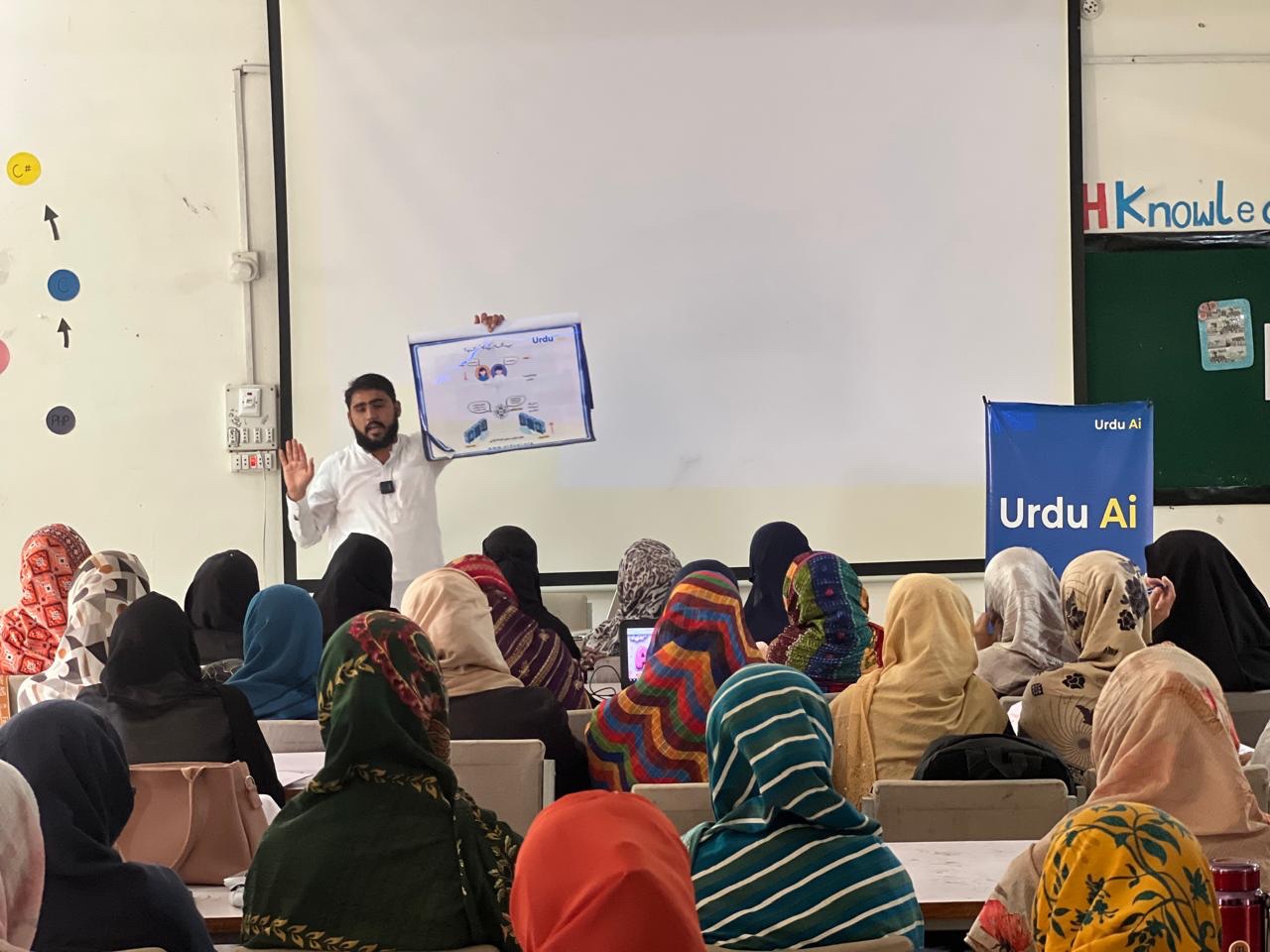
Urdu Ai combines a large public learning ecosystem with local delivery. The public side helps people discover AI in simple Urdu through videos, tutorials, and social platforms. The local side works through Urdu Ai Dost facilitators, training sessions, institutions, and community spaces where learners can ask questions and practice together.
The current public impact record includes 20,424+ people trained as of August 1, 2026, 700+ training workshops, 51% women participation, and district activity visible through the Urdu Ai Dost map. These numbers matter because they show that Urdu-language AI learning is not only a content idea. It is becoming a community education model.
Women, youth, and vocational learners should not be last
AI education in Pakistan must reach beyond early adopters. Women learners, university students, vocational trainees, rural youth, first-time internet users, teachers, nonprofit workers, and small business teams all need practical entry points.
This is where Urdu Ai's institutional partnerships matter. MoUs with universities, women-focused institutions, technical centers, and regional education partners create trusted places where learners already gather. That makes AI education easier to schedule, easier to support, and easier to continue after a first workshop.
The role of WANG, WALI, AVPN, and Urdu Ai
Urdu Ai is strengthened by an ecosystem with deep community roots. WANG brings long-standing field trust and community delivery experience. WALI, the WANG Lab of Innovation in Lasbela, shows how rural digital learning can begin close to the people who need access most. Urdu Ai extends that language-access mission into AI education across Pakistan.
The initiative is also part of the AI Opportunity Fund: Asia-Pacific, implemented by WANG in collaboration with AVPN and supported by Google.org and the Asian Development Bank. That mix of community roots, public learning, institutional access, and regional recognition is what makes Urdu Ai important for donors and partners looking for practical AI education programs in South Asia.
What partners can support next
Partners can help deepen the work in clear ways: women-led AI learning cohorts, teacher training, vocational AI skills, Dost facilitator support, institutional training pathways, learner stories, local-language curricula, and public impact updates that explain how numbers are counted.
The goal is simple: help more people understand AI in their own language, use it responsibly, and connect it to real education, work, and community needs.
Common questions
Why is Urdu-language AI literacy important?
Urdu-language AI literacy helps learners understand artificial intelligence in a language they already use, reducing the first barrier for students, teachers, women, workers, and community leaders.
Who benefits from Urdu Ai's work?
Students, teachers, women learners, vocational trainees, freelancers, rural youth, small business teams, and community facilitators benefit from practical AI education in Urdu.
How can partners support Urdu Ai?
Partners can support women-led cohorts, vocational AI skills, teacher training, Dost facilitators, institutional learning pathways, Urdu-first curricula, and public impact updates.
Partner with Urdu Ai
Urdu Ai is building practical AI literacy pathways through Urdu-first learning, Dost facilitators, institutional partners, and community access across Pakistan.